Quick answer: SPF 50 filters out about 98% of UVB rays and SPF 100 about 99%, so a higher number adds very little. For real-life protection, how much you apply, how often you reapply and whether the sunscreen also covers UVA (look for PA+++ or a “broad spectrum” label) matter far more than the number on the front.
What SPF actually measures
SPF stands for Sun Protection Factor, and it measures protection against UVB – the rays that cause sunburn. In lab tests, a sunscreen is applied at a fixed thickness (2 mg per square centimetre) and researchers check how much longer skin takes to redden compared with bare skin. An SPF 30 product should let skin take about 30 times longer to burn than unprotected skin in those test conditions, which are far more generous than real life.
The percentage of UVB blocked follows a simple formula: 1 − (1 ÷ SPF). That gives the table below. Notice how the gain flattens out.
| SPF on the label | UVB filtered (approx.) | UVB that still reaches skin |
|---|---|---|
| SPF 15 | 93% | about 1 in 15 |
| SPF 30 | 97% | about 1 in 30 |
| SPF 50 | 98% | about 1 in 50 |
| SPF 100 | 99% | about 1 in 100 |
Going from SPF 50 to SPF 100 changes the share of UVB that reaches your skin from about 2% to about 1%. That is real, but it is a small improvement compared with the difference between applying enough sunscreen and applying a thin layer.
Is SPF 100 twice as good as SPF 50?
No. The “twice” comes from the 2% vs 1% numbers above, but both products already filter almost all UVB when applied properly. Many regulators have limited labels to “50+” for this reason: in the European Union and Australia, for example, you will see 50+ rather than 100. Higher numbers can also make people feel safe enough to stay out longer or apply less, which cancels the benefit.
Where does a number like “95” fit?
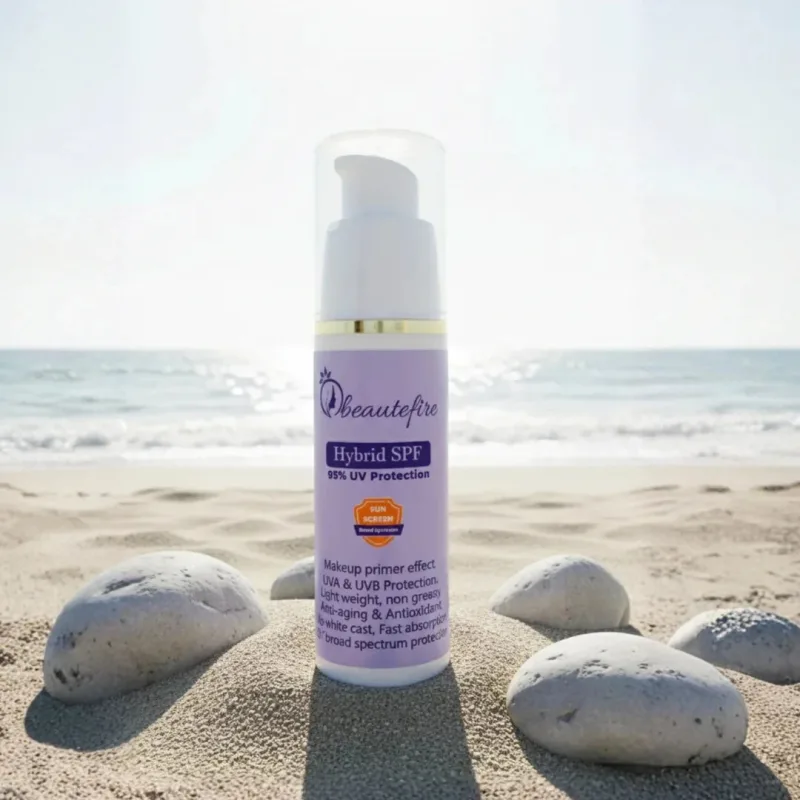
In Pakistan you will see SPF 30, 50, 60, 70 and 100 on shelves, and some products use their own naming such as “SPF 95” or “95% UV protection”. When a number is part of a product name, treat it as a name and look for the tested SPF and UVA rating printed on the carton. If a pack shows only a percentage, or only a name, ask the brand for its test report. That advice applies to every sunscreen, including ours: Beautefire’s Hybrid SPF-95% UV Protection is a broad-spectrum hybrid (chemical filters plus mineral Zinc Oxide) with no white cast, and you should check the carton for the SPF/PA values just as you would for any other brand.
UVA matters too: PA ratings and “broad spectrum”
SPF says nothing about UVA, the longer rays that go deeper into skin, contribute to tanning and dark spots, and reach you through glass and on cloudy days. Look for:
- PA+ to PA++++ (used in Japan, Korea and widely on products sold in Pakistan): more plus signs mean stronger UVA protection.
- “Broad spectrum” or a UVA in a circle logo (EU): the UVA protection meets a minimum standard relative to the SPF.
- An ingredient list with UVA filters such as Zinc Oxide, Avobenzone (Butyl Methoxydibenzoylmethane), Tinosorb-type filters or Titanium Dioxide.
What matters more than the number
- Amount. Most people apply a quarter to half of the tested amount, which turns an SPF 50 into something closer to SPF 7–15 in practice. For face and neck, a common guide is about two finger-lengths of sunscreen.
- Reapplication. Reapply about every 2–3 hours outdoors, and after sweating or wiping your face. In Pakistan’s summer the UV index regularly climbs to the “very high” and “extreme” range, so this is not optional on a long day out.
- A texture you will actually use. The best sunscreen is the one that does not feel greasy or leave a white cast on your skin tone, because you will wear it daily. Gel-creams and hybrid formulas are popular on oily and brown skin for this reason.
- The whole routine. Shade, a hat and sunglasses on peak-sun days, and sunscreen over a brightening serum so that dark spots do not return.
So which should you buy?
If a sunscreen shows SPF 50 or higher, a clear UVA rating (PA+++ or broad spectrum), a texture you like and a price you can repeat every month, that is a good product. Choose between SPF 50 and 100 on texture and comfort, not on the number alone. If you are comparing specific products, our sunscreens in Pakistan compared page lists sizes, listed filters and prices from public sources.
Frequently asked questions
Is SPF 100 worth it in Pakistan?
It can be, if you like the texture, but it is not twice as protective as SPF 50. SPF 50 already filters about 98% of UVB and SPF 100 about 99%. Applying enough and reapplying matter more than the extra point.
Which is better, SPF 50 or SPF 95?
You cannot compare them by name alone. Check the lab-tested SPF and the UVA rating (PA or broad spectrum) printed on each pack, then choose the one whose texture you will use every day and reapply on time.
Does SPF 50 protect from tanning?
A good broad-spectrum SPF 50 lowers tanning, but no sunscreen blocks everything. Tanning is driven mostly by UVA and UVB together, so use enough product, reapply and add shade or a hat.
Do I need sunscreen on cloudy days and in winter?
Yes. UVA passes through clouds and window glass, and winter sun at altitude can be strong. A daily morning application is a good habit in every season.
How much sunscreen should I put on my face?
About two finger-lengths for face and neck is a common guide. If you use a lot of makeup on top, apply sunscreen first and let it settle for a few minutes.
Can I rely on the SPF in my BB cream or foundation?
Not on its own, because you would have to apply far more than a normal layer to get the stated protection. Use a dedicated sunscreen first and treat the SPF in makeup as a bonus.
What is the difference between sunscreen and sunblock?
In everyday Pakistani use they mean the same thing. Technically, “sunblock” suggests mineral filters that sit on the skin and “sunscreen” chemical filters that absorb UV; hybrid products use both.
Does sunscreen expire?
Yes. Check the date on the pack, and avoid using sunscreen that has been left in a hot car or looks separated or smells different.
Roman Urdu mein khulasa
SPF sirf UVB (dhoop se jalne wali shuaon) se bachao batata hai. SPF 50 takreeban 98% UVB rokta hai aur SPF 100 takreeban 99%, yani farq bohot chhota hai. Asal farq is se parta hai ke aap kitni miqdar lagate hain (chehre aur gardan ke liye takreeban do ungliyon jitni), kitni baar dobara lagate hain (bahar ho to har 2–3 ghante), aur ke sunblock UVA se bhi bachata hai ya nahin (PA+++ ya broad spectrum dekhein). Agar kisi product ke naam mein 95 jaisa number ho to carton par likha tested SPF aur PA zaroor dekhein. Roz subah sunblock lagayen, sardi aur badal wale din bhi.
Related: Sunblock kab aur kitni baar lagayen? · Best sunscreen for oily skin in Pakistan · Is sunscreen necessary in winter? · Sunscreen collection · Skincare delivery in Lahore
This guide is general skincare information, not medical advice. If you have a skin condition or a history of skin cancer, ask a dermatologist which sunscreen to use.